Developed by the Taxonomy and Framework working group, which spans SPINEWORK, ForceNET, and NeuronS_MATTR
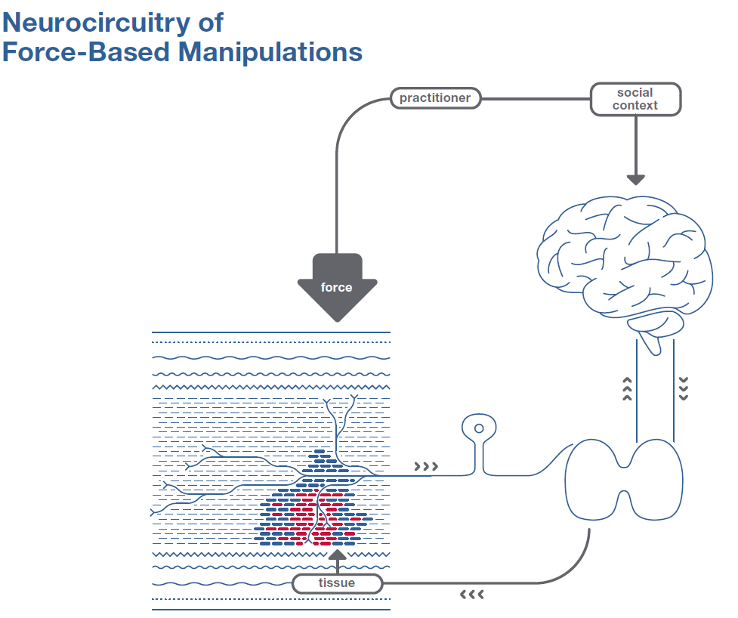
This webpage is intended to give context and framework to those studying therapeutic interventions that involve the application of forces, herein referred to as force-based manipulation (FBM). The general interaction to be described is indicated in the Figure 1 by the large arrow, "force”. Details of other parts of this figure, which represents a general model, will appear elsewhere. Forces as described in this document are relevant to all structures, including whole organisms, organs, and individual cells.
Force Types
In the most general terms, the term “force” is used to describe an interaction between objects. Forces are defined by their magnitude and a direction, and are described as "vectors." Forces may change the shape of the object or may cause or alter movement. There are two main categories of forces: contact forces and non-contact forces. Contact forces, the primary focus of this document, are those that exist when two or more objects physically interact through direct contact. Non-contact forces include gravitational force, electrical force, and magnetic force, and occur without direct physical contact. Forces can cause acceleration or deceleration, may cause an object to change its shape (deform), and may cause structural failure.
Parameters of Force
Force application can take many forms, and is influenced by several moderating factors. These include:
- Magnitude: A scalar quantity representing the strength of the force.
- Direction: Force is a vector quantity, which means it has both magnitude and direction. The direction of a force is usually specified using angles or using coordinate axes in different reference frames.
- Time: Force can result in different outcomes depending on how long it is applied on the receiving object, and whether it is applied continuously, in cycles, or other temporal variations. This can be described through measures of time, rate, or frequency of force application.
- Line of Action: The line of action of a force is an imaginary line along which the point or distributed force acts. Forces that act along a primary axis of an object are referred to as Axial forces. Forces whose line of action is not parallel to the primary axis of the object can lead to bending, torsion, and other effects.
A force’s line of action can be used to split any force into two components (normal and shear) relative to the object on which it acts.
- Normal Force: the component of a contact force that is perpendicular to the surface of an object. An example of a normal force is the one that prevents one object from passing through another.
- Compression is generated by two colinear normal forces acting in opposite direction to squeeze an object.
- Tension is generated by two colinear normal forces acting in opposite directions to stretch an object.
Shear Force: the component of a contact force acting parallel to the surface of an object. Shearing forces are generated by unaligned forces.

Figure 2. Simplified representation of normal and shear forces’ actions on objects. Initial shape in blue, shape resulting from forces (black lines) in purple. Note that in the shear case, the lines of action are parallel but not colinear. - Application area: The effect of a contact force is dependent on the area over which it is applied. The magnitude of a compressive normal force divided by the area over which it is applied is called the applied pressure.
Effects of Forces
An applied force is distributed over an object, producing a Stress within the object. The stress may be different in different locations within the object. In a deformable object, stress produces shape change (as in Figure 2).. In a deformable object, stress produces shape changes. Strain is a geometrical measure of deformation that represents the relative displacement of particles in an object (not to be confused with a stretch or a tear in a muscle or ligament, which is also called “strain”). The amount that an object deforms in response to stress is determined by its geometry and the constitutive properties of the materials from which it is composed.
Interfaces Between Application Device and Object
The geometry and material properties of the object and of the application device (hands, other body parts, or medical instrument) dictate the deformation generated in the object.
Real-World Context
Multiple types of forces are often applied simultaneously. For example, one of the most common massage methods is kneading, which involves subjecting an object to a wide range of contact forces that generate normal and shear strains within the object. It is important to note that most biological tissues are heterogeneous and do not behave in a linear elastic manner, thus requiring modification of standard mathematical frameworks used to relate stress and strain. Healthy, injured and repaired tissues are unlikely to respond similarly.
Force Moderators/Mediators
The effects of therapeutic forces are complex and can be influenced by factors such as the type of therapy, the individual's medical condition, the portion of the body treated, the tissue health, the subject’s overall health, and the skill of the practitioner. As stated above, these concepts and definitions can be applied at all levels of structure, including the entire body or cells.